Electrical Qualification Pathways
Compare the real routes into the trade — and pick the one that gives you control over how you earn.

College-First Route

Apprenticeship Route

Work-Experience Route

T-Level Progression Route
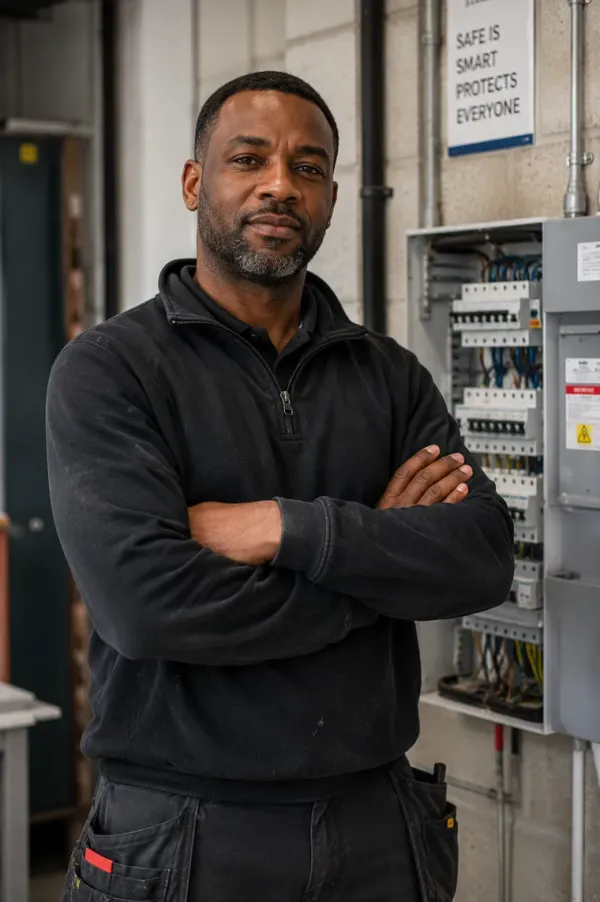
Experienced Worker Route
Explore the routes
Drag to spin the deck, then tap a card to compare it.
Work Experience3 of 5
No routes selected yet — tap up to 2 cards to compare them side by side
Compare the routes & read the full pathway guide
The 2365/8202 develop the underpinning knowledge; the 5357 NVQ proves competence (with AM2) and leads to the Gold Card. There's an experienced-worker route for those already qualified at a higher level, and the apprenticeship — the industry favourite, but limited places create a serious bottleneck. That's why we advocate the work-experience route: it puts your earning potential back in your hands.
Bored with classroom learning?
Many students find traditional education tedious, but hands-on trade work is genuinely different. You're solving real problems, earning real money, and building a practical skill that has immediate value. If you find yourself losing interest, consider the work-experience route — the pace of real work often re-engages learners far better than more years of sitting in a classroom.
Why recommendations and ECS cards matter
In practice, many temporary site opportunities do not start with a formal CV process. For short-notice site work, especially early work experience, employers and supervisors often rely heavily on word-of-mouth recommendations and an appropriate ECS card.
A trusted recommendation helps show that you are reliable, sensible, trustworthy, and worth giving a chance. The right ECS card helps show that you have met the expected health and safety standard for site access. Together, these can sometimes do more than a CV for temporary or entry-level site opportunities, because they help answer the urgent site question: can this person turn up, get through the gate, behave safely, and be useful under supervision?
For temporary site opportunities, a trusted recommendation and the right ECS card can sometimes get you further than a CV — but they do not replace competence, supervision or the recognised route to qualified status.
CVs, qualifications, right-to-work checks, insurance, employer checks, and supervision still matter. An ECS card does not prove full occupational competence on its own, and students must not work outside their competence. Early learners should only take on suitable supervised work while they build evidence, experience, and the next recommendation.
About T-Levels
Your college may offer T-Levels as an alternative. They combine classroom and workplace learning, but there is currently no clear pathway from T-Level to getting qualified as an electrician. Industry take-up is low. If your college is pushing a T-Level without a defined route to your Gold Card, consider finding a college that offers a clearer progression path.
📋 Note on costs and timelines: The durations and costs shown above are estimates based on industry standards. Actual fees, funding, and timelines vary by college, training provider, and your personal circumstances (employment, grant eligibility, etc.). Contact your college directly for current fees and expected completion dates.
| Pathway | Core Qualification / Pre-AM2 | Additional | Duration | Cost | Value |
|---|---|---|---|---|---|
College-First Route College diploma → C&G 2357 NVQ + AM2 → Gold Card | C&G 2365 / 8202 Diploma (L2/L3) ~2 years C&G 2357 NVQ Level 3 (Installation/Maintenance) ~12–18 months on-site | AM2 via NET (Practical Competence Assessment) ~3 months ECS Gold Card Automatic upon AM2 pass | ~4 years total | £3,500–5,000 (college + centre + AM2 fees) + opportunity cost | 3/5 |
Work-Experience Route★ Recommended Paid trade work + building C&G 2357 NVQ evidence → AM2 → Gold Card | Work placement + on-the-job training Flexible (learner-paced) C&G 2357 NVQ Level 3 (Installation/Maintenance) 12–18 months building evidence | AM2 via NET (Practical Competence Assessment) ~3 months ECS Gold Card Automatic upon AM2 pass | 2–4 years (you control pace & evidence gathering) | £ (earn throughout; typically £20k–35k gross over 2–4 years) | 5/5 |
Apprenticeship Route Structured programme combining classroom + workplace (ST 0152 standard) | C&G 5357 Electrician Apprenticeship (or C&G 5393 Domestic) ~4 years Includes C&G 2357 NVQ (Installation/Maintenance or Domestic) Embedded within apprenticeship | AM2S via NET (End-Point Assessment) Embedded within apprenticeship ECS Gold Card Automatic upon apprenticeship completion | ~4 years (fixed by employer & training provider) | £ (apprentice minimum wage; ~£15–18k gross over 4 years; training fully funded) | 4/5 |
T-Level Route Hybrid classroom + workplace (emerging) | T-Level Technical Qualification 2 years | Next steps to Gold Card UNCLEAR / NOT YET DEFINED | 2 yrs T-Level + undefined onward route (no clear Gold Card timeline yet) | £ (college/government funded) | 2/5 |
Experienced-Worker Assessment (EWA) For workers with significant relevant industry experience | C&G 2346 EWA (Installation/Maintenance) OR C&G 2347 EWA (Domestic) Assessment only Includes C&G 2357 NVQ (same content as apprenticeships) 6–18 months evidence gathering | AM2E via NET (Experienced Worker Assessment) ~3 months ECS Gold Card Automatic upon AM2E pass | 6–18 months (fast-track with documented experience) | ££ (assessment fees only; no training course required) | 3/5 |
College-First Route
College diploma → C&G 2357 NVQ + AM2 → Gold Card
Core qualification / pre-AM2
C&G 2365 / 8202 Diploma (L2/L3)
~2 years
C&G 2357 NVQ Level 3 (Installation/Maintenance)
~12–18 months on-site
Additional
AM2 via NET (Practical Competence Assessment)
~3 months
ECS Gold Card
Automatic upon AM2 pass
Work-Experience Route
Paid trade work + building C&G 2357 NVQ evidence → AM2 → Gold Card
Core qualification / pre-AM2
Work placement + on-the-job training
Flexible (learner-paced)
C&G 2357 NVQ Level 3 (Installation/Maintenance)
12–18 months building evidence
Additional
AM2 via NET (Practical Competence Assessment)
~3 months
ECS Gold Card
Automatic upon AM2 pass
Apprenticeship Route
Structured programme combining classroom + workplace (ST 0152 standard)
Core qualification / pre-AM2
C&G 5357 Electrician Apprenticeship (or C&G 5393 Domestic)
~4 years
Includes C&G 2357 NVQ (Installation/Maintenance or Domestic)
Embedded within apprenticeship
Additional
AM2S via NET (End-Point Assessment)
Embedded within apprenticeship
ECS Gold Card
Automatic upon apprenticeship completion
T-Level Route
Hybrid classroom + workplace (emerging)
Core qualification / pre-AM2
T-Level Technical Qualification
2 years
Additional
Next steps to Gold Card
UNCLEAR / NOT YET DEFINED
Experienced-Worker Assessment (EWA)
For workers with significant relevant industry experience
Core qualification / pre-AM2
C&G 2346 EWA (Installation/Maintenance) OR C&G 2347 EWA (Domestic)
Assessment only
Includes C&G 2357 NVQ (same content as apprenticeships)
6–18 months evidence gathering
Additional
AM2E via NET (Experienced Worker Assessment)
~3 months
ECS Gold Card
Automatic upon AM2E pass
Figures are indicative and must be confirmed by your college and awarding body. 'Value' reflects earning agency & access, not qualification prestige.
This tool is for guidance. Final decisions about credit transfer, exemptions, and progression must be confirmed by your college and awarding body.
| Pathway | Time to Gold Card | Cost / Funding | Value |
|---|---|---|---|
| ~4 years total | £3,500–5,000 (college + centre + AM2 fees) + opportunity cost | 3/5 | |
| Recommended | 2–4 years (you control pace & evidence gathering) | £ (earn throughout; typically £20k–35k gross over 2–4 years) | 5/5 |
| ~4 years (fixed by employer & training provider) | £ (apprentice minimum wage; ~£15–18k gross over 4 years; training fully funded) | 4/5 | |
| 2 yrs T-Level + undefined onward route (no clear Gold Card timeline yet) | £ (college/government funded) | 2/5 | |
| 6–18 months (fast-track with documented experience) | ££ (assessment fees only; no training course required) | 3/5 |